
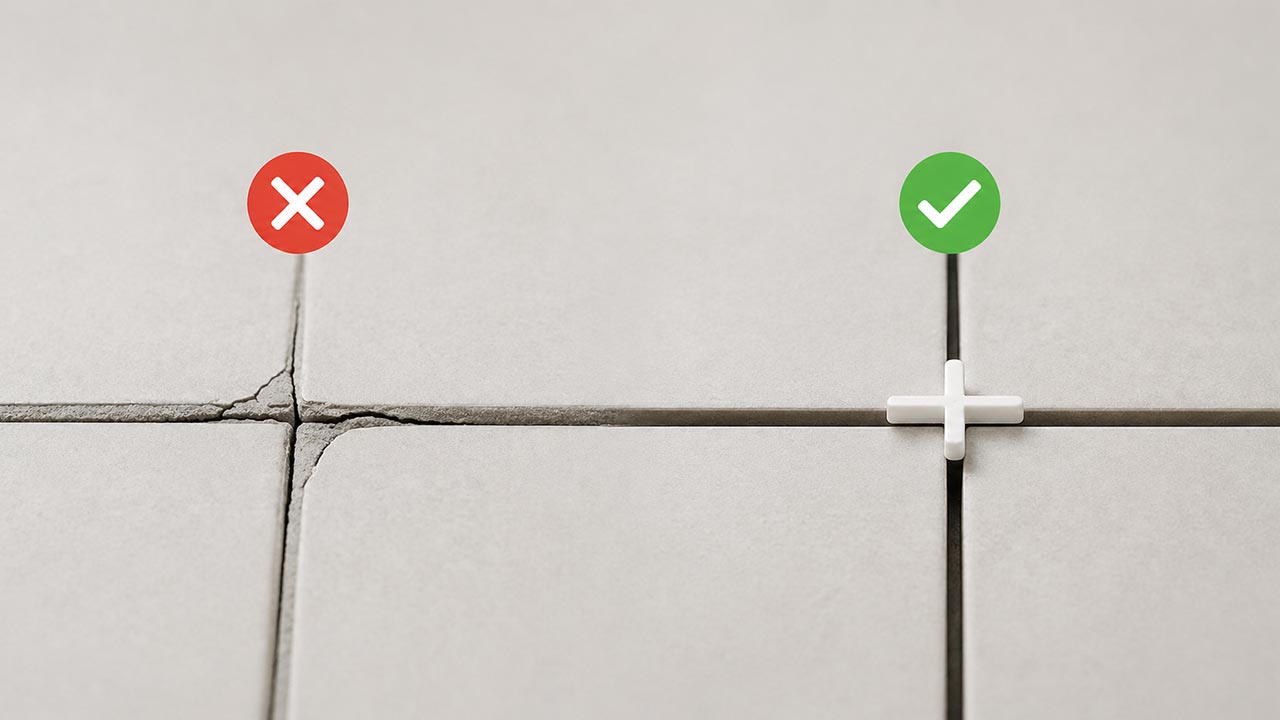
Why do joints crack?
Joints most often crack due to uneven spacing between tiles, movement of tiles during drying, and insufficient substrate stability.
In other words, the problem is most often not in the grout – but in the way the tiles are laid.
Why do joints crack?
Cracking of joints is not accidental. It is a consequence of the stress that occurs when tiles are not installed correctly.
The most common causes are:
- uneven spacing between tiles
- movement of tiles while the glue is drying
- uneven or poorly prepared surface
- insufficient stability of the tiles
- uneven load distribution
When tiles are not properly fixed, the joint takes on pressure that it cannot withstand — and then cracking occurs.
What are joints and why are they important?
Grouts are a connecting material between tiles that allows:
- absorption of minimal displacements
- even distribution of stress
- surface protection
If the distance is not properly defined, the joint loses its function and becomes a weak point of the entire surface.
Biggest mistake: focusing on the wrong place
One of the most common mistakes is trying to solve the problem by changing the grout.
In reality:
Cracking joints are most often not a problem with the material, but with the way the tiles are laid.
If the substrate is unstable or the distance is uneven, even the best quality joint will not prevent cracking.
How to prevent joints from cracking?
In order for the joints to remain stable and long-lasting, it is crucial to ensure the correct placement of the tiles.
Key steps:
- use tile spacers for even spacing
- ensure a flat and prepared surface
- use levelers for tile stability
- prevent movement during drying
- adjust the spacing to the size of the tiles
This is the foundation of long-lasting results.
What are tile crosses?
Tile spacers are spacers that ensure equal spacing between tiles and an even joint.
Without them, the distance is determined “by eye”, which almost always leads to errors.
When are joint problems most common?
Cracking of joints is particularly pronounced in:
- large format tiles
- floor surfaces
- terrace and outdoor spaces
- uneven surfaces
In these situations, precision becomes crucial.
Stable base = long-lasting joints
If the tiles are laid correctly, the grout will not crack.
Fugue is not a solution to the problem – it only monitors the quality of performance.
Long-lasting results without cracking
If you want to avoid cracking joints, the focus must be on proper installation — not on subsequent repairs.
Check out our range of tile crosses and levelers and ensure a stable and long-lasting result. https://dd-innovation.hr/product/4-level/
FREQUENTLY ASKED QUESTIONS (FAQ)
Why do joints crack after laying tiles?
The most common reason is uneven spacing and movement of the tiles, which creates stress in the joints.
What spacing between tiles prevents joints from cracking?
Usually 2–3 mm, using a tile cross for precision.
Can a bad grout cause cracking?
Less common — in most cases, the cause is poor tile installation.
Are levelers necessary?
They are almost essential for large formats because they prevent the tiles from moving.
How to prevent cracking of joints in the long term?
By using a cross, a level and proper preparation of the surface.